
A look at how different risk levels behaved — including the option of not investing at all.
Money you invest can go up or down.
That is true of every portfolio, ours included. Nobody can switch that off. But "investing your CPF" is not one thing. It comes in levels. So "how did it do?" has no single answer — it depends which level you mean, and whether you invested at all.
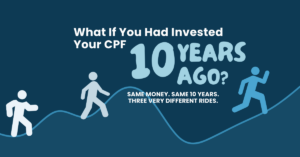
The easiest way to see that is to follow three people. Same money, same ten years, three different choices. First, though, one thing about the numbers.
1. Where these numbers come from
Our CPF portfolios launched in 2025. So a full ten years of real client accounts does not exist yet. We cannot show you something we do not have.
What we can show you is a backtest. Think of a flight simulator. We take the portfolios exactly as they are built today, drop them into real market history, and watch how they would have flown through it. The figures are after fees.
A simulator is still worth watching. It shows the shape of the ride — how far a portfolio historically dropped when markets dropped, and how long it historically took to climb back. That shape is the useful part, but it is not a promise about the next ten years.
2. Three friends
It is the year 2016. Three friends each have S$10,000 sitting in their CPF Ordinary Account on top of their S$20,000 OA balance.
- Friend 1 leaves it in the OA. CPF OA pays at least 2.5% a year — the floor set by law, not a fund return. Picture a travelator at the airport. Slow, smooth, always moving forward. It never lurches, and never sprints. Plenty of people choose this on purpose.
- Friend 2 picks Risk 3. Risk levels work a bit like gears. Risk 3 is a middle gear: money spread across the world, leaning toward 60% stocks and 40% bonds. More of the steady stuff in the mix.
- Friend 3 picks Risk 5. High gear. Same global spread, 100% stocks. More market exposure, and more movement with it.
Now we follow all three for ten years.
3. The bumpy bits
Ten years is never a smooth climb for an invested portfolio. Markets had three frightening stretches in this window. Friend 1 barely notices any of them; the travelator just keeps going.
2018 dip
A short, sharp pullback across global markets — the shallowest of the three, and the quickest to heal for both invested portfolios.
COVID crash (2020)
The deepest fall in the window, but also one of the fastest bounces back — markets dropped hard and snapped back within months.
2022 slide
Not the deepest drop of the three — but by far the slowest climb back. Over a year of seeing less than what was put in.
Backtested illustration — simulated figures, not live client results.
The same pattern shows up all three times. The high gear fell further than the middle gear. The middle gear fell further than the travelator, which did not fall at all.
That is the trade-off in plain sight. Falling further is not a fault in how a portfolio is built — it is what more market exposure has looked like on the way down.
Then the recovery. In this window, each dip healed with time, and the charts show how long that took. Read those durations slowly. Living it means looking at your portfolio month after month and seeing less than you put in.
4. The picture


| Friend | Ending value |
|---|---|
| Friend 1 — OA (2.5% floor) | S$12,645 |
| Friend 2 — Risk 3 | S$20,845 |
| Friend 3 — Risk 5 | S$29,837 |
Backtested illustration — simulated figures, not live client results.
Three different numbers. But look at the lines again first. Each friend sat through a different ride to get there. That is the real difference between them.
5. The dips on TV are in fact different
Knowledge box: what is leverage (margin trading)?
Leverage means investing with borrowed money. Say you put in $10,000 and borrow another $20,000 — you are now moving with a $30,000 position.
It amplifies both directions. Gains are multiplied, and so are losses, so a fall hits your own money several times harder. The part people miss: with leverage you can lose more than you invested, and still owe the lender the difference.
"Margin" is the lender's protection. When prices fall you must top up cash immediately, and if you cannot, your investments are sold from under you.
CPF investing involves none of this. Without borrowing, gains and losses are never amplified this way.
Go back to Friend 3 in the 2020 crash. His balance fell 28.7%.
If you watch enough television, you know the scene that usually follows. So why does his story not go there? Because those people were playing a different game.
Hong Kong television built a genre on that game — The Greed of Man (大時代, TVB, 1992) is the one everyone remembers. In those dramas, one crash takes everything — savings, homes, and in the darkest tellings, lives. But those characters were not investing their own money. They were making concentrated bets with borrowed money.
In South Korea, mid-2026, the KOSPI fell roughly a quarter from its June peak. Retail traders had borrowed record amounts on margin and crowded into new products engineered to double the daily moves of one single stock, mostly two big chipmakers.
Over a million of those accounts hit margin calls — when you invest with borrowed money and prices fall, the lender wants its money back at once. Hundreds of thousands were closed out by their brokers, and retail losses are estimated at around US$39 billion.
A wipe-out like that needs three ingredients: borrowed money, everything on one bet, and someone who can force you out at the bottom. AutoWealth's CPF investing has none of them.
There is no borrow button. You can only invest savings already sitting in your OA, and nobody lends you extra against it. So there is nothing to owe, no lender to come knocking, and no margin call is possible.
Friends 2 and 3 cannot lose more than the $10,000 they put in. There is no single bet. Their money sits across thousands of companies in many countries, at calculated risk, not one stock doubled.
Nobody can close them out. Unlike those Korean accounts, Friends 2 and 3 pick their own moment. A dip only becomes a loss if they sell into it.
None of this makes our dips painless, and none of it promises that a dip comes back. Friend 3's fall was real money. But the failure mode is different: our chart's dips are bruises, not the cliff-edge from the dramas.
6. What we steer, and what nobody steers
What AutoWealth can steer
- Spreading your money across many countries and asset types, instead of a few bets.
- Setting the mix by the gear you picked — not by us guessing where markets go next.
- Rebalancing to a rule, steadily, rather than reacting to headlines.
- Keeping fees low and visible, whatever markets do.
What nobody can steer
- Markets fall sometimes, and sometimes sharply. That applies to every gear above the travelator.
- Any invested portfolio can lose money in the short term.
- Recovery took as long as it took in this window. It may look different next time.
- What happened before does not tell you what happens next.
7. Questions worth sitting with
Nobody here is telling you which friend to be. That is your call.
These questions help you make it:
- When do you actually need this money?
- Is this CPF OA money set aside for a flat or a housing loan soon?
- If you opened your app and saw your balance down 10.2% in one month — honestly, what would you do next?
- The at-least-2.5% floor is yours to keep. Would you trade it for the chance of more, or hold on to it?
There is no right answer, and this article is not nudging you toward one. What you do with your CPF OA, and at which gear, depends on your own situation.
Not sure where you'd sit on the risk spectrum? Ask Tammy, our wealth manager — no pressure, no obligation.