Keeping cash in a standard bank savings account feels safe because your principal balance never drops. However, in wealth management, there is a big difference between nominal safety (the number on your screen staying the same) and real purchasing power (what that money actually buys over time).
While leaving idle cash in the bank eliminates market volatility, it carries a silent, guaranteed cost: cash drag and inflation erosion.
If you are exploring how to protect your cash savings, here is a clear breakdown of what leaving money in the bank actually costs you, and separately, what a low-fee, globally diversified approach to investing has historically aimed for.
1. The Silent Wealth Killer: Inflation vs. Bank Interest
Your money loses value when standard bank savings rates fail to keep up with inflation in Singapore:
- Standard Savings Accounts: Base accounts typically offer around 0.05% p.a. High-Yield Savings Accounts (HYSAs) offer higher promotional rates, but often come with strict salary crediting tiers or spending caps.
- Core Inflation in Singapore: Long-term core inflation historically averages around 2.0% to 3.0% p.a.
When inflation outpaces your interest rate, your purchasing power shrinks every year:
Real Return = Nominal Bank Interest Rate − Inflation Rate
| Account Type | Nominal Rate (Long Term) | Real Return (At 2.5% Inflation) |
|---|---|---|
| Standard Bank Savings | ~0.05% p.a. | -2.45% p.a. |
| High-Yield Bank Account (HYSA) | ~1.50% – 3.00% p.a. | -1.00% to +0.50% p.a. |
This table compares cash-based accounts only — nominal interest against inflation on the same underlying asset (cash). It does not include any investment product.
The Real-World Cost: If you keep S$50,000 in a standard bank account earning 0.05% p.a. for 10 years while inflation averages 2.50% p.a., your bank balance will show S$50,250. However, in terms of real purchasing power, that money is only worth roughly S$39,200 today (a 20%+ loss in actual wealth).
You don't need a spreadsheet to feel this, just look at your lunch. A plate of chicken rice that cost around S$2.50 in 2010 will set you back roughly S$5 today. Your salary may have grown over that time, but if your savings didn't grow at the same pace, every dollar sitting idle in the bank buys noticeably less chicken rice (or anything else) than it used to. That's inflation, made tangible.
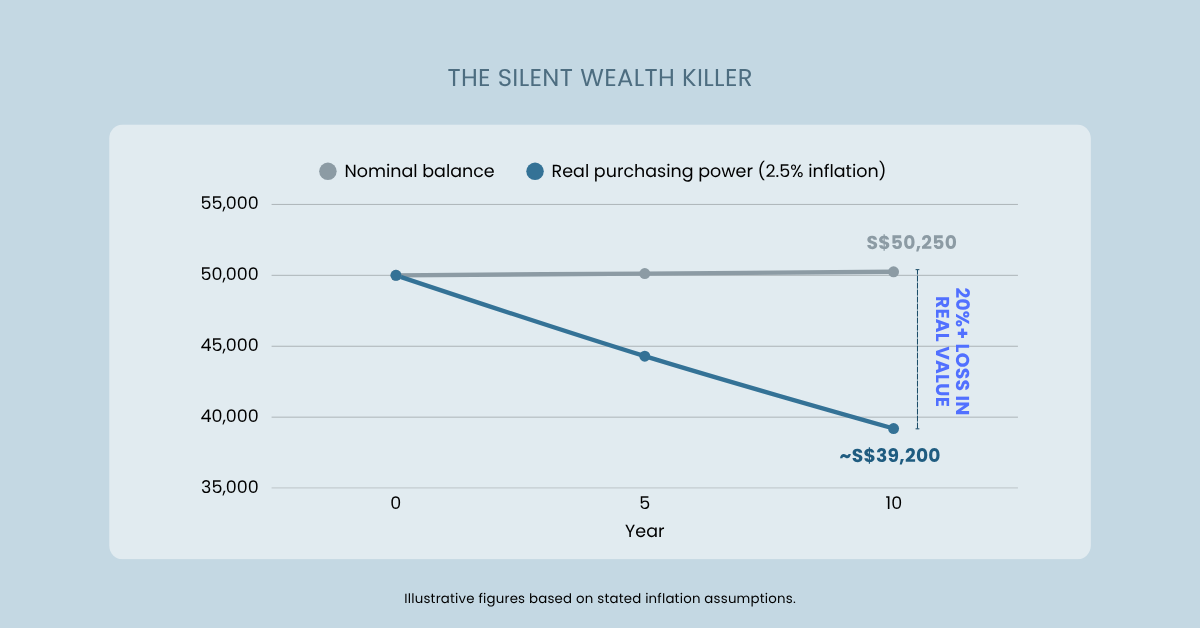
Illustrative figures based on stated inflation assumptions.
2. What a Diversified Investment Approach Has Historically Targeted
Separately from bank cash management, it's worth understanding what a globally diversified investment portfolio has historically aimed to achieve over long time horizons.
AutoWealth's Starter Portfolio (e.g., Risk 3) has targeted an expected long-term return of approximately 8.74% p.a., which, after adjusting for 2.5% inflation, represents a real return of approximately 6.24% p.a.
This is a projection based on historical asset class performance, not a guarantee. Investments always involve risk, including the possibility of loss of principal. Past performance is not necessarily indicative of, and is no guarantee of, future or likely performance.
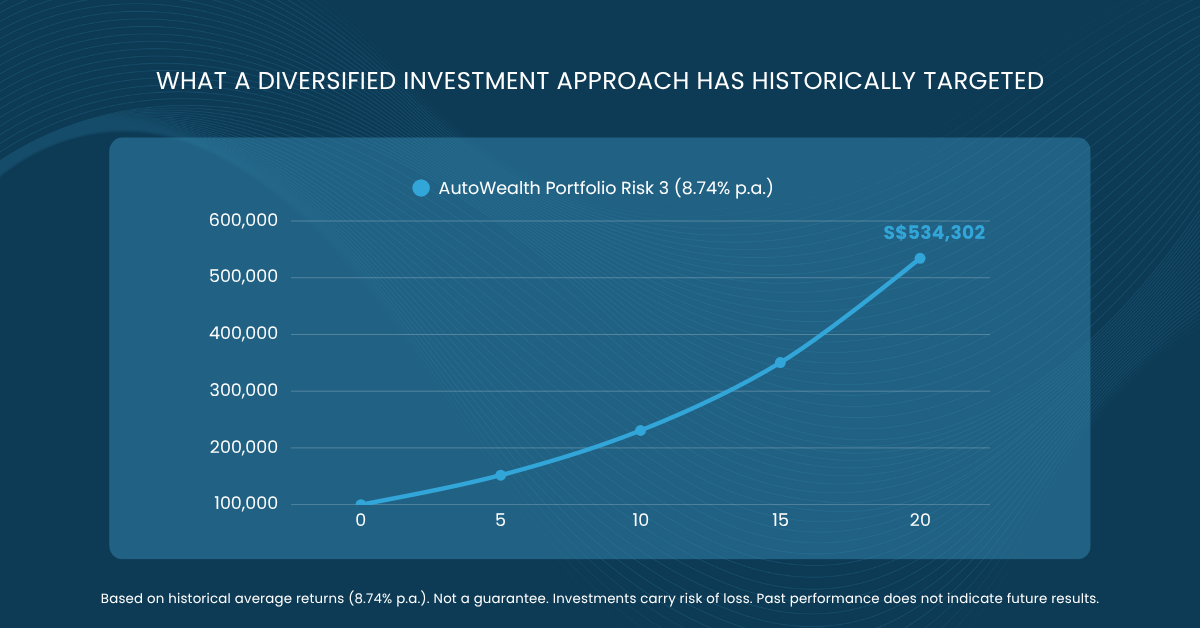
Based on historical average returns (8.74% p.a.). Not a guarantee. Investments carry risk of loss. Past performance does not indicate future results.
3. How Much Cash Should You Actually Keep in the Bank?
Investing doesn't mean moving every single dollar out of your bank. A simple, pragmatic guideline for cash management includes:
- Emergency Reserve: Keep 3 to 6 months of essential living expenses in an accessible bank account for unexpected emergencies or job transitions.
- Short-Term Goals: Keep cash earmarked for purchases within the next 12 to 24 months (like a house downpayment) in liquid, safe accounts.
- Long-Term Savings: Any capital meant for goals 5+ years away could be considered for productive, growth-generating global assets, based on your own risk appetite and financial goals.
4. Why AutoWealth Helps Your Money Work Harder
When moving cash into global markets, minimizing fees is essential so high investment charges don't erode your returns:
- Low Fees: AutoWealth Flexi Cash charges 0.1% while AutoWealth Starter charges 0.5% and USD$18 per annum (Flat Fee) regardless of the investment amount. AutoWealth Plus+ charges an 8% performance fee on profits.
- Dedicated Support: You get direct WhatsApp access to a MAS-licensed Wealth Manager to guide your onboarding and asset allocation.
Take Action: Stop Cash Drag Today
Leaving excess cash idle in the bank may feel secure, but inflation steadily erodes your purchasing power over time. By maintaining a lean emergency fund and considering a low-cost, globally diversified portfolio for your long-term capital, you can take a more active approach to protecting your long-term financial future.
With AutoWealth, you get zero lock-in periods, institutional-grade diversification, and full transparency.
Disclaimer: Investments always involve risks and the possibility of losses. Any reference to past performance is not necessarily indicative of and is no guarantee to the future or likely performance of your investments.